



Written By – Ajima Akter Sujana
South Asia is rapidly moving toward a digital-first financial future. What once seemed like a long-term technological vision is now becoming an economic reality across the region. From mobile banking and QR-code payments to AI-driven fintech systems, digital transactions are steadily transforming how consumers spend money, how businesses operate, and how governments manage financial systems.
Countries like India, Bangladesh, and Pakistan are leading this transformation through large-scale fintech expansion, government-backed digital infrastructure, and growing internet accessibility. The rise of smartphones, affordable mobile data, and digital banking platforms has accelerated financial inclusion and opened new opportunities for businesses, startups, and financial institutions.
The transition toward a cashless economy is creating measurable economic value. Faster transactions, lower operational costs, improved transparency, and stronger financial access are helping South Asian economies become more efficient and digitally connected than ever before.
What Is a Cashless Economy?
A cashless economy refers to a financial ecosystem where transactions are primarily conducted through digital payment systems instead of physical cash. Consumers and businesses use mobile banking apps, QR-code payments, debit and credit cards, internet banking, and digital wallets to complete transactions quickly and securely.
The objective is not to eliminate cash entirely but to reduce dependency on paper currency by making digital payments more convenient, transparent, and accessible.
Across South Asia, digital payments are becoming deeply integrated into daily life. From online shopping and ride-sharing payments to utility bills and small retail transactions, digital finance is reshaping consumer behavior and commercial activity.
Why South Asia Is Moving Toward a Cashless Economy
Several major factors are accelerating digital finance adoption across the region:
- Rapid smartphone penetration
- Affordable internet access
- Growth of fintech startups
- Government support for digital infrastructure
- Rising consumer preference for convenience
- Expansion of e-commerce ecosystems
The COVID-19 pandemic also played a major role in accelerating digital payment adoption, as both businesses and consumers shifted toward contactless transactions.
Today, digital payments are no longer limited to urban populations. Small retailers, street vendors, transportation services, and rural businesses are increasingly adopting mobile financial solutions.
The Economic Benefits of a Cashless Economy
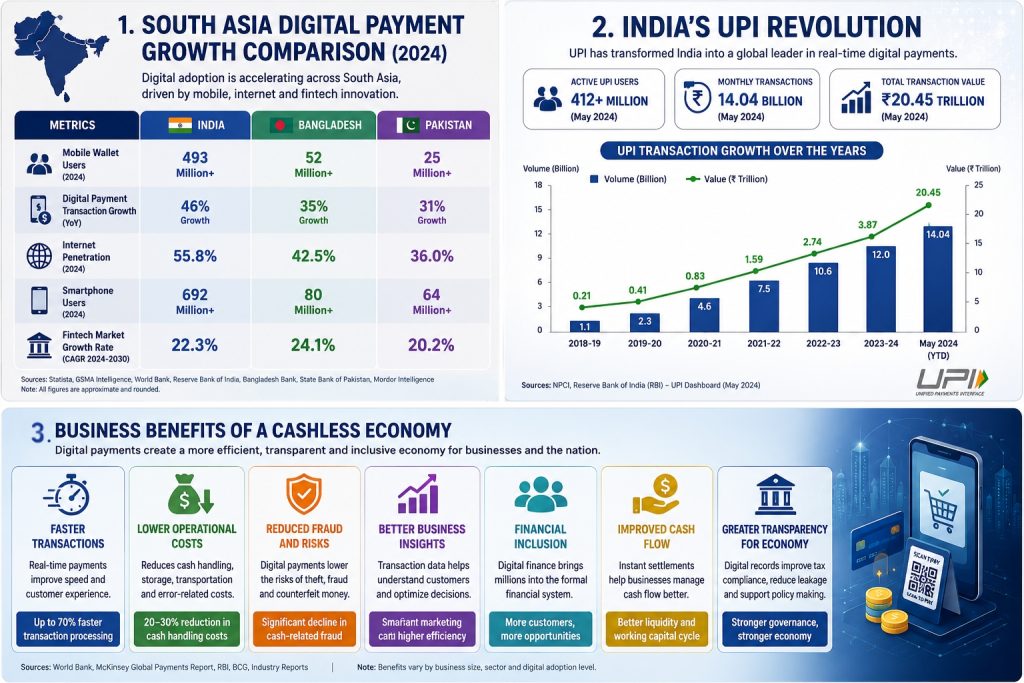
The shift toward digital finance is delivering significant economic and business advantages across South Asia.
Faster and More Efficient Transactions
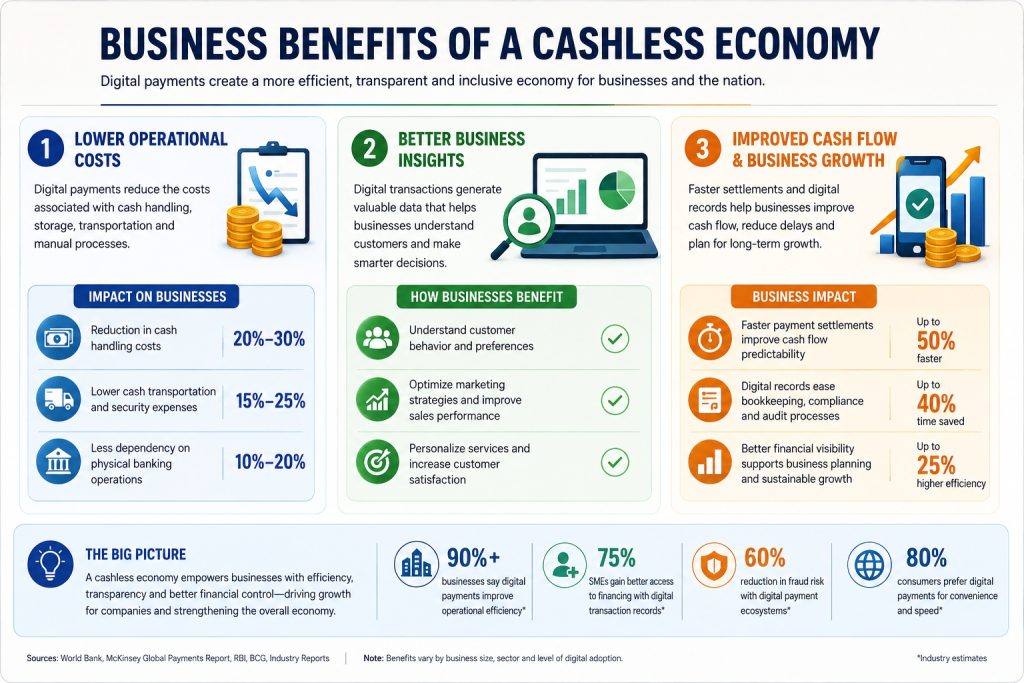
Digital payments significantly reduce transaction processing time for both businesses and consumers. Businesses can receive payments instantly, improving cash flow and operational efficiency.
Improved Financial Transparency
Electronic transactions create traceable financial records, helping reduce corruption, tax leakage, and informal cash-based activity. This improves overall financial governance.
Lower Operational Costs
Businesses spend less on cash handling, physical banking processes, transportation, and security management associated with paper currency.
Financial Inclusion
Mobile financial services are helping millions of previously unbanked individuals access financial systems for the first time. This is especially important in rural and underserved communities.
Growth of E-Commerce and Startups
Strong digital payment ecosystems support online shopping, digital services, and startup growth by making transactions easier and more secure.
Better Business Intelligence
Digital transaction data allows businesses to understand customer behavior, optimize marketing strategies, and improve decision-making through financial analytics.
India’s Digital Payment Revolution
India has emerged as one of the world’s strongest examples of digital financial transformation.
The country’s Unified Payments Interface (UPI) has revolutionized how consumers and businesses conduct transactions. UPI enables instant bank-to-bank transfers with minimal friction, making digital payments accessible across both urban and rural markets.
From multinational retailers to small roadside vendors, digital transactions have become a standard part of everyday commerce in India.
The impact extends beyond convenience. Digital transaction histories are now helping financial institutions evaluate loan eligibility for small businesses and individuals without traditional banking records. This is improving access to credit and supporting economic participation.
India is also investing heavily in the next generation of fintech innovation, including:
- AI-powered fraud detection
- Voice-enabled payments
- Biometric authentication
- Cross-border digital payment systems
These developments are positioning India as a major influence on the future of digital finance across South Asia.
Bangladesh’s Rapid Fintech Expansion
Bangladesh is becoming one of South Asia’s fastest-growing fintech markets, driven by the widespread adoption of mobile financial services.
Platforms like bKash have transformed how millions of people send money, pay bills, receive salaries, and conduct business transactions. Mobile wallets are now deeply connected to everyday economic activities, particularly among small businesses and informal workers.
QR-code payments are also expanding rapidly across the country. Retail stores, restaurants, transportation services, and local businesses increasingly rely on digital payments due to their convenience and low operational cost.
Meanwhile, Bangladesh Bank continues to promote financial digitization through digital banking initiatives and fintech-focused policy development.
The business impact is significant:
- Reduced risks associated with handling physical cash
- Improved transaction transparency
- Better financial recordkeeping
- Increased access to institutional financing
Bangladesh’s fintech growth demonstrates how digital finance can drive broader economic participation and business modernization.
Pakistan’s Digital Finance Transformation
Pakistan is also making major progress in digital finance through the expansion of its real-time payment infrastructure, RAAST.
The platform enables faster, lower-cost transactions for consumers and businesses while encouraging broader adoption of digital banking services.
More importantly, digital payment systems are helping integrate businesses into the formal financial economy. Improved transaction visibility strengthens taxation systems, financial governance, and long-term economic planning.
For businesses, digital records improve financial credibility and increase opportunities for banking support, investment access, and business financing.
Pakistan’s progress highlights how strategic fintech infrastructure can modernize financial systems even in traditionally cash-dependent economies.
The Business Value of Digital Payments
The future of South Asia’s cashless economy is not only about technology—it is fundamentally about economic efficiency and business growth.
Digital payment systems help businesses:
- Improve transaction speed
- Strengthen cash flow management
- Reduce operational delays
- Minimize cash-handling risks
- Enhance customer experience
At the same time, digital ecosystems generate valuable data that businesses can use to:
- Analyze customer behavior
- Improve marketing strategies
- Personalize services
- Optimize financial planning
Financial institutions also benefit from stronger consumer data and alternative credit profiling, which improve lending decisions for SMEs and underserved populations.
Governments are gaining advantages as well through:
- Better tax transparency
- Reduced financial leakage
- Improved public fund distribution
- More efficient welfare systems
The Next Phase of Digital Finance
The next evolution of South Asia’s cashless economy will be driven by advanced technologies such as Artificial Intelligence (AI), blockchain systems, and Central Bank Digital Currencies (CBDCs).
AI-Powered Financial Systems
AI is already being used for:
- Real-time fraud detection
- Risk analysis
- Customer behavior prediction
- Automated financial services
As digital transaction volumes continue to rise, AI-driven cybersecurity systems will become increasingly important.
Blockchain Technology
Blockchain offers secure, transparent, and decentralized financial recordkeeping. Financial institutions are exploring blockchain solutions to improve transaction verification and reduce fraud risks.
Central Bank Digital Currencies (CBDCs)
Several South Asian governments are exploring CBDCs as part of long-term digital finance strategies. Unlike cryptocurrencies, CBDCs are backed by central banks, providing greater stability and regulatory trust.
These technologies are expected to reshape the region’s financial ecosystem over the next decade.
Challenges Still Remain
Despite rapid progress, several challenges continue to affect South Asia’s transition toward a fully digital financial economy.
Cybersecurity Risks
The growth of digital transactions increases the risk of:
- Fraud
- Hacking
- Phishing attacks
- Financial data breaches
Continuous investment in cybersecurity infrastructure remains essential.
Digital Inequality
Many rural communities still face:
- Limited internet access
- Low digital literacy
- Limited access to smartphones and banking services
Without addressing these issues, financial inclusion may remain uneven.
Regulatory and Privacy Concerns
Governments must balance innovation with:
- Consumer protection
- Data privacy
- Financial regulation
- Cybersecurity governance
Public trust will play a critical role in long-term adoption.
Final Thoughts
The future of the cashless economy in South Asia represents far more than a technological transition. It reflects a broader economic transformation centered around efficiency, accessibility, transparency, and digital connectivity.
India, Bangladesh, and Pakistan are demonstrating how digital payment ecosystems can reshape commerce, expand financial inclusion, and accelerate economic modernization.
As fintech innovation continues to evolve, South Asia is emerging as one of the world’s most dynamic digital finance regions. The region is no longer simply adapting to global financial trends—it is actively helping shape the future of digital commerce and financial technology.



